



🧩 What Is the Humber Suspension Bridge?
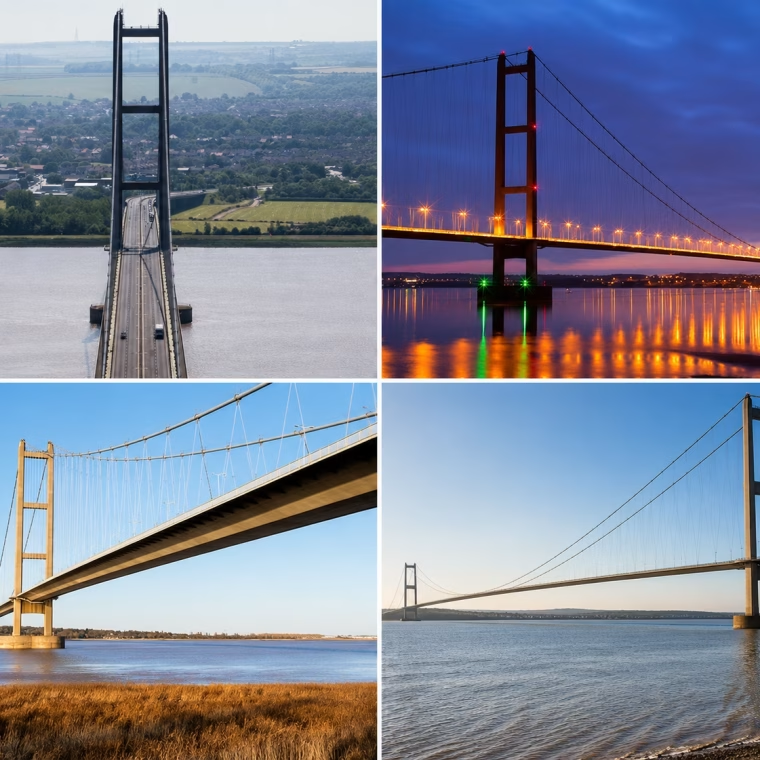
The Humber Bridge is a single-span suspension bridge that carries the A15 road across the Humber Estuary, linking Hessle on the north bank in East Yorkshire with Barton upon Humber on the south bank in Lincolnshire. Its main span of 1,410 metres made it the longest of its kind anywhere in the world when it opened, and it remains one of the most impressive feats of structural and civil engineering ever completed in the United Kingdom.
In headline terms: the total length of the bridge, including its approach viaducts, is approximately 2,220 metres. The towers rise 155.5 metres above the waterline. The bridge opened officially in 1981 and, after being surpassed by Japan’s Akashi Kaikyō Bridge in 1998, currently ranks among the top ten longest suspension bridges on the planet. It holds Grade I listed status, the highest level of protection awarded by Historic England.
For structural engineers and construction professionals, the Humber Bridge is far more than a crossing. It is a working demonstration of how carefully engineered geometry, aerodynamic deck design, and precision cable fabrication can combine to produce a structure that has stood in a demanding tidal environment for over four decades without fundamental compromise to its integrity.

🧩 History: From Act of Parliament to Opening Day
The story of the Humber Bridge begins not with engineers but with politicians. A fixed crossing of the Humber Estuary had been discussed since the nineteenth century, and a private member’s bill as early as 1872 proposed a tunnel. It was the Humber Bridge Act of 1959 that finally gave the project legal authority, establishing the Humber Bridge Board to oversee its delivery. Even then, funding remained uncertain for years.
The decisive moment came during the 1966 Kingston upon Hull North by-election. The Labour government, keen to secure a marginal seat, committed to funding the bridge as part of its campaign. That political promise turned a long deferred aspiration into a funded project. Design work was approved in the late 1960s, contracts were awarded in 1972, and construction began that same year. The project would take roughly nine years to complete.
HM Queen Elizabeth II officially opened the Humber Bridge on 17 July 1981, a moment that marked the end of a construction effort spanning more than a decade and the beginning of a new era of connectivity for the region. The opening represented a high-water mark for British infrastructure ambition and helped establish the country’s reputation for delivering complex long-span engineering projects.

🧩 Design and Structural Engineering Explained
The Humber Bridge was designed by the consulting engineering practice Freeman Fox & Partners, led by Sir Gilbert Roberts. The practice had already made its name with the Severn Bridge, and the Humber commission allowed them to push single-span suspension bridge design further than it had gone before. The core engineering challenge was simple to state and enormously difficult to solve: how do you bridge a 1,410 metre gap across a fast-moving tidal estuary with structures that will remain stable and safe for a century or more?
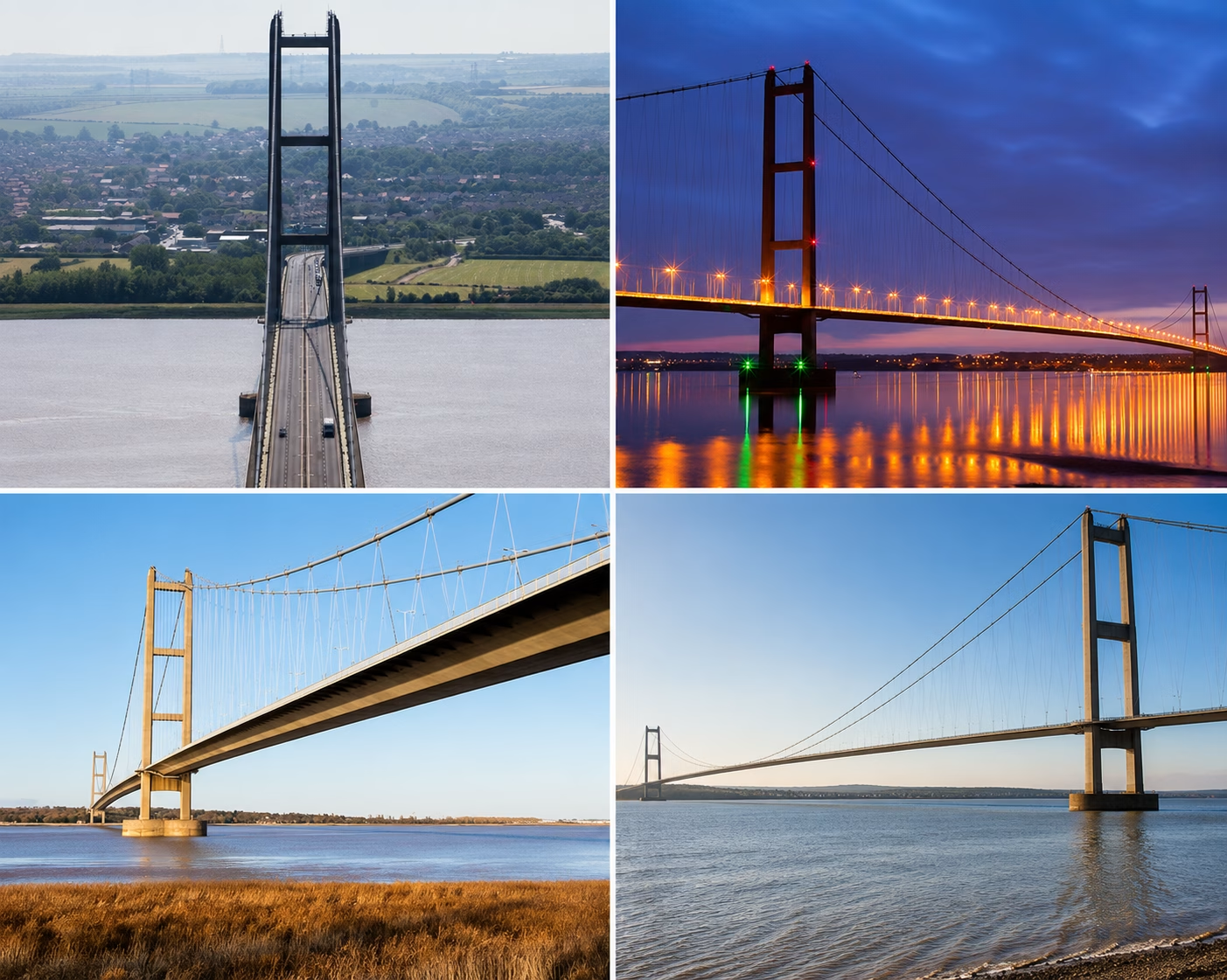
One of the most elegant engineering decisions, and one that surprises many visitors when they learn of it, is that the two main towers are not perfectly parallel. They lean very slightly outward from each other: approximately 36 millimetres over their full height. This is not a construction error. At a span of 1,410 metres, the curvature of the Earth itself becomes a measurable factor, and the towers were deliberately inclined to remain truly vertical relative to the Earth’s surface at their respective foundations. It is a detail that encapsulates the precision thinking behind the whole project.
The main cables, from which the deck is suspended, were assembled on site using a process called aerial spinning. Each cable contains 14,948 individual wires of high-tensile steel; in total, approximately 44,000 kilometres of wire were spun into the two main cables. The deck itself uses a hollow, aerodynamic box section rather than the open lattice truss favoured on earlier long bridges. This choice, influenced partly by lessons learned after the 1970 failure of the original Tacoma Narrows Bridge and subsequent aerodynamic research, reduces wind resistance and improves the structure’s dynamic stability under load.
Have any questions?
Contact the experts today!
🧱 Construction: Building the Humber Bridge
Building the Humber Bridge presented engineers and contractors with a formidable set of practical challenges. The Humber Estuary is subject to strong tidal flows and a substantial tidal range, and both tower foundations had to be constructed in these demanding conditions. The north tower foundation sits on chalk beneath the estuary bed; the south tower rests on boulder clay. Different ground conditions on each bank required different foundation engineering approaches, adding complexity from the very start.
The towers themselves were built using a slipform concrete technique, which allowed continuous vertical construction without the delays involved in conventional formwork. Once the towers were complete and the cable spinning process finished, deck sections, fabricated off site as hollow steel box units, were lifted into position from barges below and connected incrementally outward from each tower using a cantilevering method. This approach allowed the span to close progressively without the need for temporary support from below, which would have been impractical over a navigable tidal estuary.
Approach viaducts on both the Lincolnshire and Yorkshire shores connect the main suspension span to ground level, threading across the floodplains on concrete A-frame piers. Key construction milestones included the completion of the first cable strand, the mid-span deck closure in the late 1970s, and an extensive programme of pre-opening load testing to verify that the structure performed as designed before public traffic was permitted.

💡 Bridge Statistics and World Records
The numbers behind the Humber Bridge are worth setting out clearly. The main span is 1,410 metres. The total length including approach viaducts is approximately 2,220 metres. Each tower stands 155.5 metres above high-water level. The two main cables each contain 14,948 wires, and the combined wire length across both cables is approximately 44,000 kilometres. The deck sits around 30 metres above the water at mid span, providing clearance for shipping.
From 1981 until 1998 the Humber Bridge held the title of the world’s longest single-span suspension bridge. It was overtaken by the Akashi Kaikyō Bridge in Japan, which has a main span of 1,991 metres. The Humber Bridge currently ranks outside the top five globally by main span length but remains the longest bridge of any kind in the United Kingdom and is the longest suspension bridge in the UK.
In 2017 Historic England awarded the bridge Grade I listed status, recognising it as a structure of exceptional interest, both for its pioneering engineering and for what the organisation described as its sublime design quality. Grade I is the highest tier of listed building protection, awarded to fewer than two per cent of all listed structures, and its conferral on the Humber Bridge places it in the same category as the great cathedrals and country houses of England.

💡 Visiting the Humber Bridge: Entry, Prices & Local Benefits
The Humber Bridge is open to cars, motorcycles, cyclists, and pedestrians. Crossing on foot or by bicycle is free in both directions, the bridge has dedicated footways and cycle tracks separated from the carriageway, making it a popular route for recreational cyclists and walkers who want a remarkable estuary-level perspective on the structure. The views from the walkway, looking out across the Humber to the flat Lincolnshire Wolds on one side and the East Yorkshire landscape on the other, are genuinely striking.
Vehicle tolls apply to motorised traffic crossing northbound (towards Hessle and Hull). Toll rates are subject to periodic review and the bridge authority has undertaken a modernisation of the toll plaza in recent years; current charges are best confirmed directly with the Humber Bridge Board before travel, as they may have been updated. The Humber Bridge Country Park on the north bank provides car parking, walking trails along the foreshore, and viewing points from which the full scale of the structure can be appreciated.
Beyond the visitor experience, the bridge has delivered lasting economic benefits to the region. Before 1981, the only way to cross the Humber by road was a lengthy detour via Goole, adding significant time and cost to journeys between Yorkshire and Lincolnshire. The bridge cut that journey dramatically and opened up new patterns of employment, commerce, and development across both banks, a concrete example of how well-engineered infrastructure shapes regional economies for generations.
💡 Incidents, Finances, and Ongoing Management
The Humber Bridge carries a difficult association alongside its engineering achievements. Like several other high structures in the UK, it has been the site of a significant number of suicides over the decades, a fact that has prompted the bridge authority and partner organisations to introduce a range of safety and prevention measures including increased signage, helpline information, and physical interventions. These measures reflect a broader awareness within infrastructure management that landmark structures carry responsibilities to the communities they serve that go beyond traffic flow and toll revenue.
Financially, the bridge’s history has been troubled. The final construction cost rose well above original estimates, partly due to high inflation in the 1970s and the length of the construction period. The debt that accumulated, at one point one of the largest debts carried by any local infrastructure authority in the UK, took many years to resolve. The Humber Bridge Board successfully lobbied the government for a debt restructuring deal, and the bridge’s finances have since been placed on a more sustainable footing, with toll revenues now directed toward maintenance and improvement rather than historic interest payments.
The Humber Bridge Board governs the crossing and is responsible for its ongoing maintenance, safety management, and capital investment programme. In recent years the Board has invested in upgrading the toll plaza and supporting infrastructure, reflecting a commitment to keeping a forty-year-old structure operating safely and efficiently well into the twenty-first century.
💡 The Humber Bridge and Structural Engineering Today
More than four decades after its opening, the Humber Bridge continues to offer lessons for practising structural and civil engineers. Its cable design, aerodynamic deck section, and tower geometry have informed a generation of long-span bridge projects around the world. The decision to use hollow steel box sections for the deck, lighter and more aerodynamically stable than earlier truss designs, has become standard practice on major suspension bridges built since 1981.
For engineers working on a much smaller scale, house extensions, structural wall removals, residential developments, the principles that underpin a structure like the Humber Bridge are not so different in kind from those applied every day on domestic and commercial projects. Load paths, material efficiency, the behaviour of structures under dynamic and static forces: these fundamentals run through every well engineered project, whether it spans 1,410 metres or the back wall of a Victorian terrace.
At Paddick Engineering, our work is grounded in exactly that kind of rigorous structural thinking, applied to projects across Leeds, Bradford, Hull, York, Harrogate, and beyond. We have been delivering structural and civil engineering design since 1981, the same year the Humber Bridge opened, and we bring the same commitment to structural integrity and careful, considered design to every commission we take on, from a single storey extension to a complex multi-plot development.
Frequently Asked Questions About the Humber Bridge
Fascinated by the engineering behind landmark structures? At Paddick Engineering we bring that same passion for structural integrity to your project, whether it’s a home extension, a structural survey, or a complex development. Get in touch with our Leeds-based team today for a friendly, no obligation conversation.
Is the Humber Bridge the longest suspension bridge in the world?
No. The Humber Bridge held the record as the world’s longest single-span suspension bridge from 1981 until 1998, when it was surpassed by the Akashi Kaikyō Bridge in Japan. It is, however, the longest bridge of any type in the United Kingdom and the longest suspension bridge in the UK.
Has the Humber Bridge ever collapsed?
No, the Humber Bridge has never collapsed. Since opening in 1981 it has operated continuously and remains structurally sound, maintained by the Humber Bridge Board under an ongoing programme of inspection and investment.
Where is the longest suspension bridge in the UK?
The Humber Bridge, crossing the Humber Estuary between Hessle in East Yorkshire and Barton-upon-Humber in Lincolnshire, is the longest suspension bridge in the UK, with a main span of 1,410 metres.
How much does it cost to cross the Humber Bridge?
Pedestrians and cyclists cross the Humber Bridge for free in both directions. Vehicle tolls apply to motorised traffic travelling northbound; rates are subject to change and are best confirmed with the Humber Bridge Board directly before your journey.
Who designed the Humber Suspension Bridge?
The Humber Bridge was designed by the consulting engineering practice Freeman Fox & Partners, with Sir Gilbert Roberts as the lead engineer. The practice had previously designed the Severn Bridge and was among the leading long-span bridge engineering firms in the world at the time.
How long did the Humber Bridge take to build?
Construction began in 1972 and the bridge was officially opened by HM Queen Elizabeth II on 17 July 1981, making the construction period approximately nine years.
Why do the Humber Bridge towers lean outward?
The towers lean very slightly outward, by approximately 36 millimetres over their full height, to account for the curvature of the Earth. At a span of 1,410 metres, the Earth’s surface curves measurably between the two foundations, so the towers were inclined to remain truly vertical relative to the ground at each base rather than perfectly parallel to each other.
What is the main span length of the Humber Bridge?
The main span of the Humber Bridge is 1,410 metres, making it the longest single span suspension bridge in the UK.
Is the Humber Bridge Grade I listed?
Yes. Historic England awarded the Humber Bridge Grade I listed status in 2017, recognising it as a structure of exceptional interest for its pioneering engineering and sublime design. Fewer than two per cent of listed structures in England hold Grade I status.
How much did the Humber Bridge cost to build?
The original budget was exceeded significantly due to high inflation during the 1970s and the length of the construction period. The final cost ran to several hundred million pounds and resulted in a substantial long-term debt that the Humber Bridge Board eventually resolved through a government-supported restructuring deal; a precise independently verified final figure is not confirmed in publicly available sources.